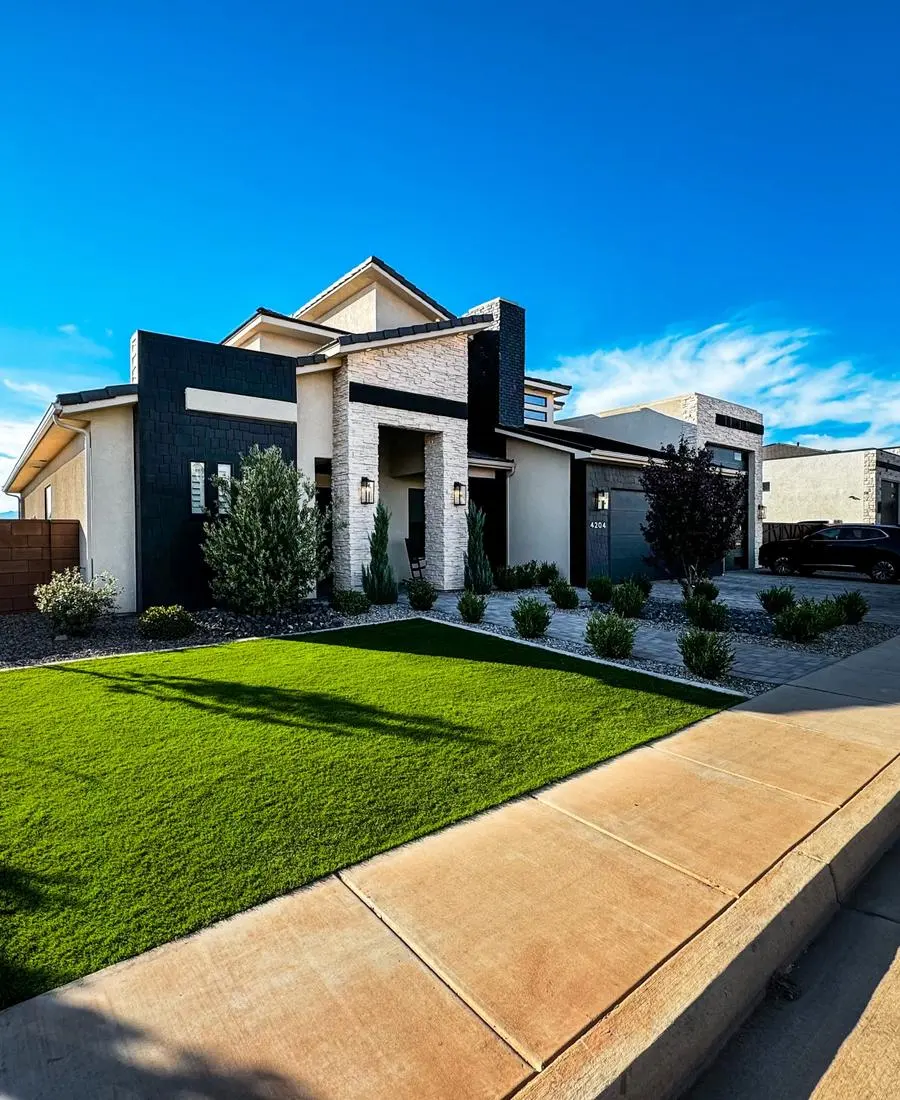
 Artificial Turf
Turf cost in St. George
How artificial turf is priced in St. George, why two yards of the same size quote differently, and what base prep actually includes in a real bid.
Read the guide
Artificial Turf
Synthetic turf versus a natural lawn in Southern Utah: water use, appearance year-round, maintenance, heat, pets, cost, and who should keep their grass.
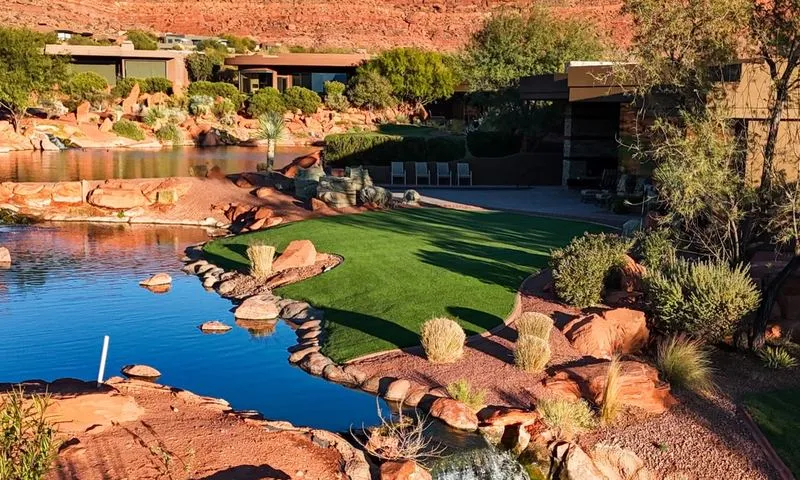
The short version
In the desert Southwest, natural grass requires daily summer irrigation and still looks rough for part of the year. Turf eliminates water, mowing, and fertilizer and looks identical every day — at the cost of running warm in direct afternoon sun and a larger upfront number.
Lawns in Southern Utah are an import. The grass species that make up a traditional American lawn evolved in temperate, reliably wet climates, and keeping them alive in a place that gets a few inches of rain a year and routinely clears 105°F means continuously fighting the environment.
That’s not an argument that nobody should have grass here. It’s context for a comparison that’s often presented too simply in both directions.
This is the dominant difference and it isn’t close.
A natural lawn in St. George needs irrigation essentially every day through the summer just to survive — not to look good, to survive. Consumption runs into the thousands of gallons per month for a typical residential lawn. That’s the single largest discretionary water use on most properties in the region.
Turf needs none. The irrigation zone gets capped at install. Occasional rinsing for cleaning or cooling uses a rounding error by comparison.
The context that makes this matter more every year: Washington County water rates have been trending upward, and conservation pressure across the Colorado River basin isn’t easing. A lawn that was merely expensive a few years ago is increasingly both expensive and restricted.
Here’s where desert reality diverges sharply from the brochure version of a lawn.
Cool-season grasses (fescue, bluegrass) look good in spring and fall and struggle badly in July and August. Heat stress produces thinning, browning, and dead patches no matter how much you water — and watering more in extreme heat often makes fungal problems worse.
Warm-season grasses (Bermuda) handle the heat far better but go dormant and brown for months in winter. That’s normal and healthy for the plant, and it means a tan lawn from roughly November through March unless you overseed annually.
Either way, a natural lawn here looks genuinely good for part of the year and compromised for another part.
Turf looks the same every day. February, July, after a monsoon, during a freeze. For a lot of people that consistency, more than the water savings, is what sells it.
| Natural grass | Artificial turf | |
|---|---|---|
| Watering | Daily in summer | None |
| Mowing | Weekly in season | None |
| Fertilizing | Several times a year | None |
| Weed control | Ongoing | Occasional edges only |
| Aeration / dethatching | Annually | None |
| Reseeding / overseeding | Annually or as needed | None |
| Pest treatment | As needed | None |
| Remaining upkeep | — | Rinse occasionally, brush traffic lanes, blow off leaves |
The time dimension is worth naming separately. A natural lawn here is a recurring obligation — either your Saturday mornings or a monthly service bill. Turf removes the obligation entirely, which is a different kind of value than dollars.
This is where natural grass genuinely wins, and we won’t pretend otherwise.
Grass cools itself through evapotranspiration. Turf, like concrete, pavers, decking, and decorative rock, absorbs solar radiation and gets warm in direct sun.
What reduces it: heat-reflective infill (meaningful), shade (most effective of all), and a 30-to-60-second rinse (immediate and substantial). What it compares to: your patio and driveway, not your grass.
If your primary use case is barefoot toddlers in a full-sun western-exposure yard with no shade plan, this is worth taking seriously. We cover it honestly in does artificial turf get hot.
Turf usually wins this one, which surprises people.
Real grass plus dogs in a desert climate typically means dug-up holes, mud after every watering, dead yellow urine spots, and worn dirt tracks along the fence line. Repairing it is a continuous project.
Turf with a drainage-optimized base and antimicrobial infill doesn’t develop any of that. Urine flushes through rather than sitting in the backing, there’s nothing to dig up, and it rinses clean.
The caveat is the same heat consideration — shade, infill choice, and timing walks for morning and evening. Which you’d want to do anyway, since asphalt and concrete get hotter than turf.
Both work. A few honest distinctions:
Turf is more consistent — no mud, no bare patches, no holes, playable the day after rain. It’s also firmer than a thick natural lawn, though a proper base with adequate infill is considerably more forgiving than people expect, and shock pads are available for play areas.
Natural grass is softer when it’s healthy, and cooler. The qualifier matters: a healthy natural lawn in July in St. George is not a given.
The two options have fundamentally different shapes.
Natural grass: low cost to install, continuous cost to maintain. Water every month of summer forever, plus mowing, fertilizer, weed control, reseeding, and repairs. The cost never ends and the water portion keeps rising.
Turf: substantial cost once, then effectively nothing. Priced per square foot installed, driven heavily by excavation and base work.
In the desert Southwest the crossover generally arrives within a few years, and every water rate increase pulls it closer. The honest qualifier: payback depends on your yard size, your actual water rate, and whether you currently pay for lawn service. Worth running your real numbers rather than trusting a generic figure — we’ll do that at the estimate.
See what turf costs in St. George for the full breakdown of what drives the install number.
We’d rather say this plainly than oversell:
It doesn’t have to be all or nothing. A common and sensible approach: turf the high-visibility, high-use areas — the front yard, the main play area, a dog run — and keep planting beds, trees, and shaded areas natural with drip irrigation.
That captures most of the water savings and most of the appearance benefit while keeping real plants where they do well. We design this way often.
Want real numbers for your yard? Request a free on-site estimate — we measure, check the sub-grade and drainage, and leave a written price.
Written by
The Avid Home Services install team
We install permanent lighting across 11 markets and artificial turf in St. George, Utah. More about us →
Keep Reading
Artificial TurfHow artificial turf is priced in St. George, why two yards of the same size quote differently, and what base prep actually includes in a real bid.
Read the guide Artificial Turf
Yes, turf runs warmer than shaded grass in full sun. Here is why, how much it matters in a desert climate, and what genuinely lowers surface temperature.
Read the guide Permanent Lighting
Why early fall is the real deadline for holiday lights, what a spring or summer install gets you, and how far ahead you need to book a crew.
Read the guideFree Estimate
We show up, measure your home, and give you an exact number on the spot. No deposit to get a quote, no pressure, no gimmicks.