 Buying Guide
What permanent lighting costs
How permanent lighting is actually priced, what drives the number up or down, and how to compare bids without getting fooled by a low per-foot rate.
Read the guide
Buying Guide
Permanent roofline lighting compared to seasonal Christmas lights: cost over time, appearance, labor, safety, and when seasonal lights really do win.
The short version
Seasonal lights cost less once and more forever. Permanent lighting costs more once and then functions as year-round architectural lighting, not just a December display. If you only care about Christmas and you own the house short-term, seasonal still wins.
Most comparisons of these two options are written by companies selling one of them, which makes them useless. So here is the version that includes the cases where you should not buy permanent lighting.
Seasonal lights win if: you’re renting or selling within a couple of years, you genuinely only want lights in December, you enjoy putting them up, or your budget simply doesn’t have room for the one-time cost right now.
Permanent lighting wins if: you’re staying in the house, you’re already paying someone to hang lights annually, you’re over climbing ladders, or — this is the one most people don’t anticipate — you’d actually use architectural accent lighting the other eleven months of the year.
The rest of this is the detail behind that.
The comparison people usually make is “one big number versus one small number,” which isn’t the real comparison.
Seasonal lighting has a recurring cost structure. If you hire it out, you pay for installation and removal every single year, often with a storage fee, and pricing tends to rise with demand. If you do it yourself, you pay for strands that degrade, replacement bulbs, clips, timers, and an afternoon of your own labor — plus replacement strands when a quarter of them fail in storage.
Permanent lighting has a one-time cost structure. Install once, then the ongoing cost is electricity, which for LEDs running a warm white scene is roughly comparable to leaving a few bulbs on.
The payback window depends almost entirely on what you’re currently paying. Someone hiring a professional crew annually reaches break-even in a handful of seasons. Someone who hangs a few strands themselves takes much longer in pure dollars — and for that person, the argument has to be something other than cost.
Here’s what the pure cost comparison misses: a permanent system is not a holiday product.
Seasonal lights are on for roughly six weeks and then they’re gone. A permanent system is on most nights of the year, almost always in a soft warm white that traces your gables, dormers, and peaks. That’s the same effect homeowners pay architectural lighting designers for, and it’s completely absent from the seasonal option.
So the real comparison isn’t “permanent lighting versus seasonal lights.” It’s “permanent lighting versus seasonal lights plus a separate architectural lighting project you might want anyway.”
Once you frame it that way, the holiday colors start looking like a bonus feature rather than the point.
This is where the gap is widest, and it’s worth being specific.
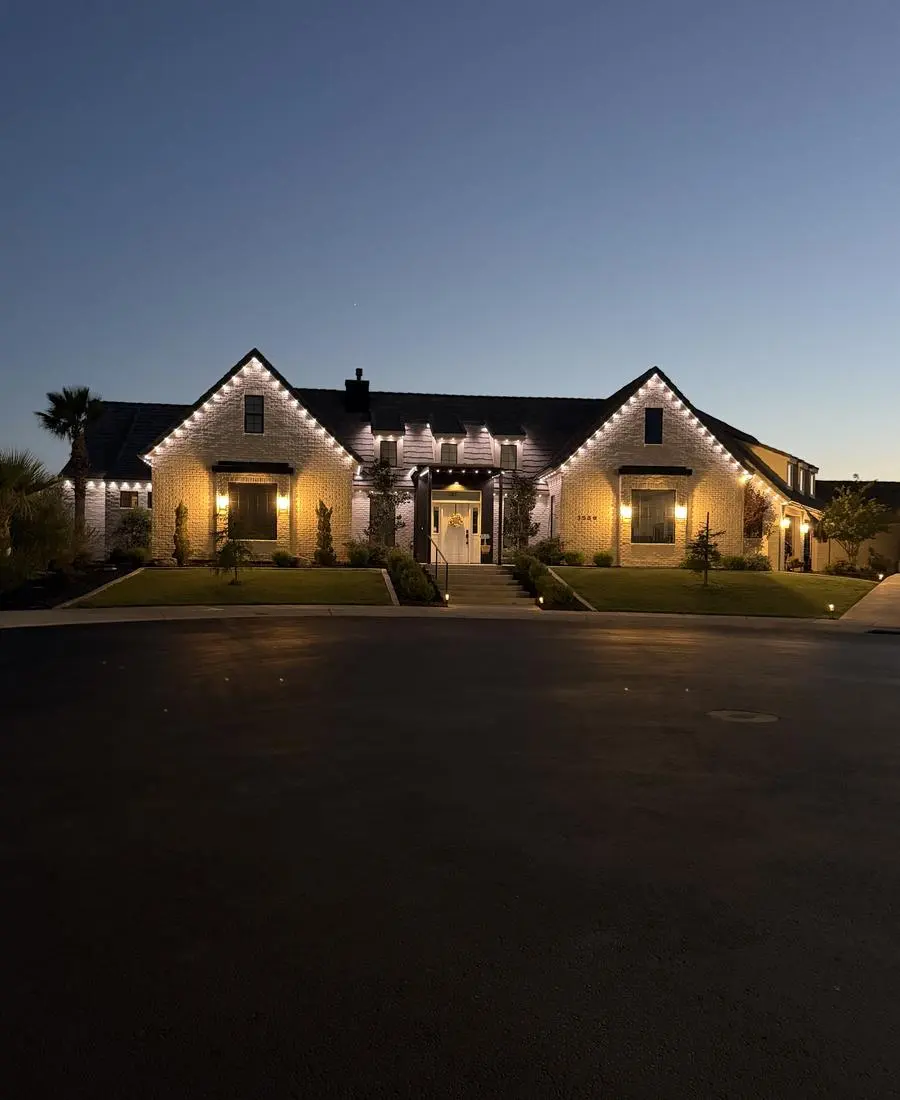
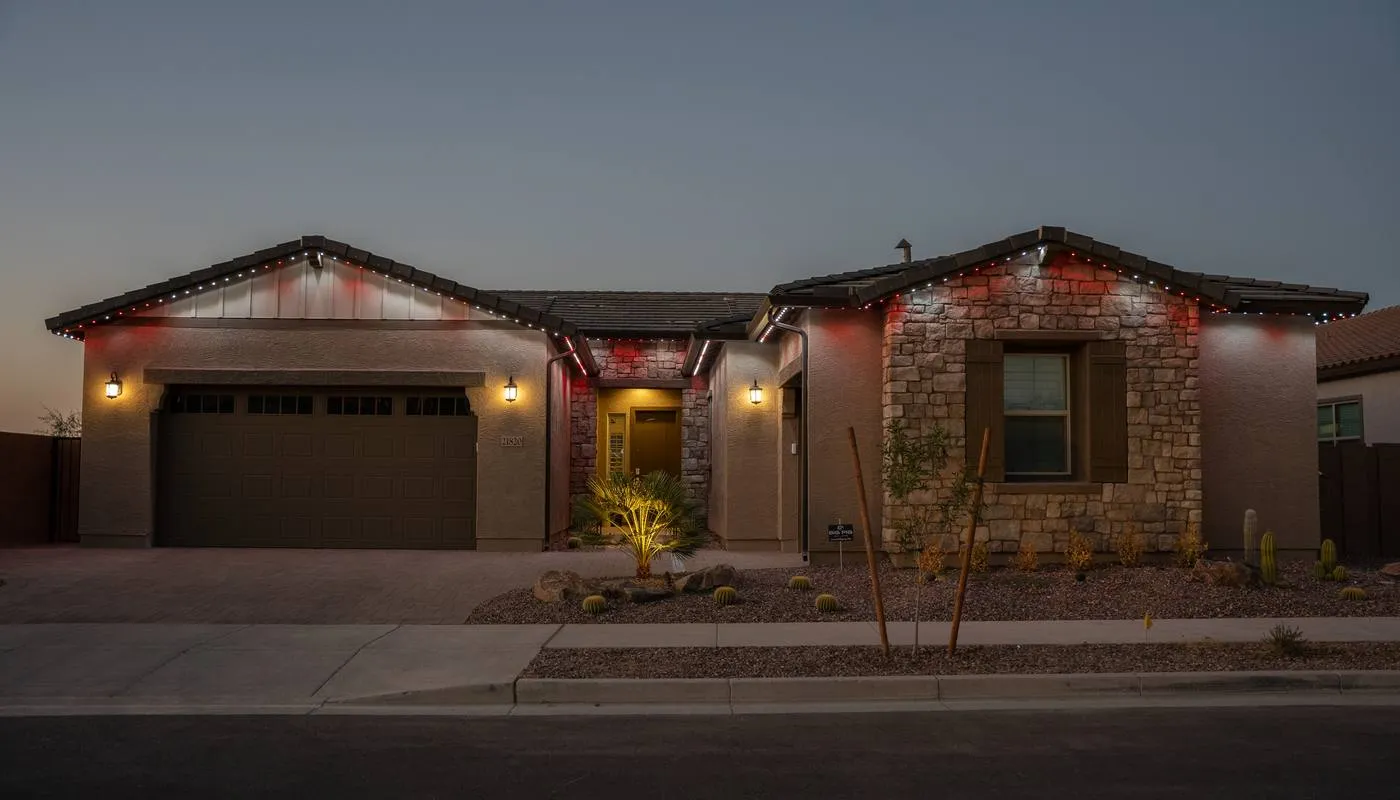
During the day, seasonal strands are visible — clipped along the gutter line, with cord runs down to an outlet. A permanent channel is color-matched to your fascia and sits flush against it, so from the street it reads as a shadow line. Most people can’t identify it as lighting until it comes on.
At night, the difference is pattern control. Traditional strands are one static color per strand. Permanent systems use individually addressable fixtures, which means each point can be a different color simultaneously. Red, white, and blue is three distinct colors repeating along the roofline. With a traditional setup you’d need three separate strands woven together to approximate that, and it still wouldn’t animate.
Over time, seasonal strands sag as clips loosen and slip, which is why a display that looked crisp on December 1st often looks tired by New Year’s. A mechanically fastened channel holds its line.
This is the reason a lot of people make the switch, and it tends to be underweighted until someone has a close call.
Seasonal lighting means being on a ladder twice a year, typically in November wind and January ice, at roof height, handling cords. Falls from ladders are a leading cause of serious home-maintenance injuries, and the risk doesn’t improve with age.
Permanent lighting means one professional install, and then every change after that happens from your phone. There’s no second trip up, no storage bins in the garage, and no untangling anything.
Seasonal strands are fixed in color. Changing the look means buying different strands and re-hanging them.
Permanent systems change instantly. Practically, that means:
The scheduling piece matters more than people expect. You can assign scenes to calendar dates, which means Halloween and Christmas simply happen without you opening the app at all.
| Seasonal lights | Permanent lighting | |
|---|---|---|
| Cost structure | Lower once, recurring every year | Higher once, then electricity only |
| Visible in daylight | Yes — strands and cords | Barely — flush, trim-matched channel |
| Color changes | Buy and re-hang strands | Instant, from an app |
| Multi-color patterns | Limited and static | Addressable, animated |
| Ladder work | Twice a year, every year | Once, by the installer |
| Seasonal storage | Bins in the garage | None |
| Used outside December | No | Yes — most nights of the year |
| Automatic scheduling | Basic timer at best | Sunset and calendar-based |
| Typical lifespan | A few seasons per strand | Years, under warranty |
| Best for | Renters, short stays, December-only | Long-term owners, year-round use |
We’d rather tell you this than sell you something you’ll regret:
Two things worth reading before you commit: our breakdown of what permanent lighting costs and what makes quotes differ, and whether your HOA will approve it, which is the most common hesitation we hear.
When you’re ready, request a free on-site estimate. We measure your roofline in front of you and leave a written price — no deposit, no deadline.
Written by
The Avid Home Services install team
We install permanent lighting across 11 markets and artificial turf in St. George, Utah. More about us →
Keep Reading
Buying GuideHow permanent lighting is actually priced, what drives the number up or down, and how to compare bids without getting fooled by a low per-foot rate.
Read the guide Permanent Lighting
Why early fall is the real deadline for holiday lights, what a spring or summer install gets you, and how far ahead you need to book a crew.
Read the guide Artificial Turf
How artificial turf is priced in St. George, why two yards of the same size quote differently, and what base prep actually includes in a real bid.
Read the guideFree Estimate
We show up, measure your home, and give you an exact number on the spot. No deposit to get a quote, no pressure, no gimmicks.